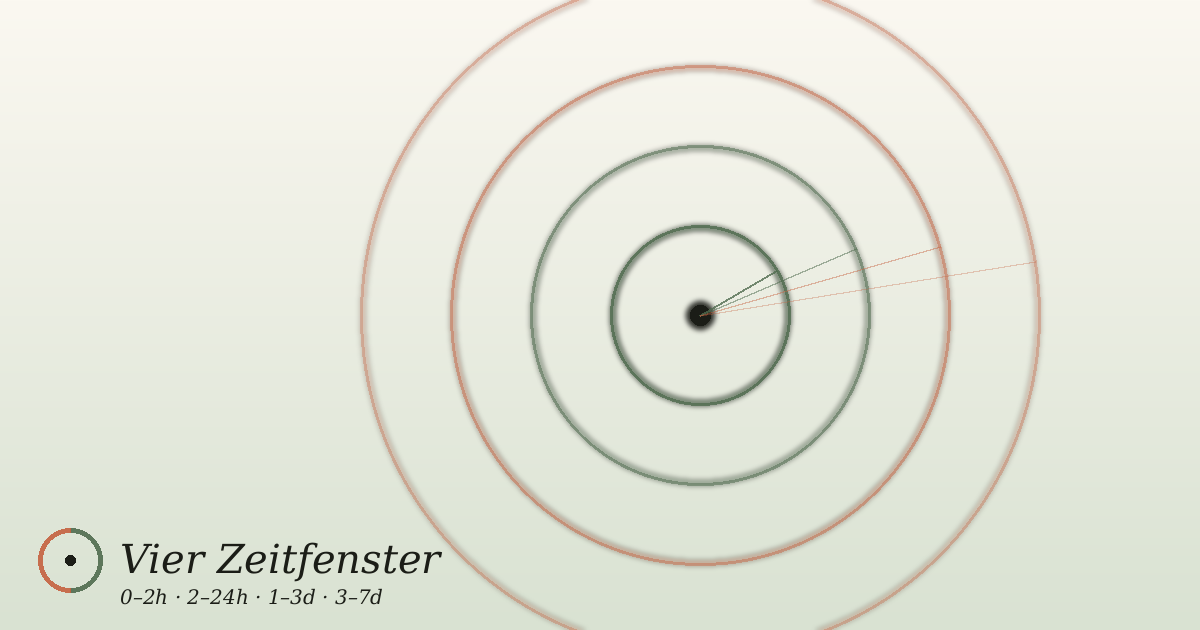
One time window is not enough
When someone says “I can’t tolerate X”, there is rarely a single time pattern. An example:
- Glutamate (e.g. in soy sauce): reaction often within 30 minutes.
- Histamine-rich meals: symptoms often 4–12 hours later, sometimes up to the next morning.
- FODMAPs (fermentable carbohydrates, Tuck et al. 2019): bloating often 24–48 hours later due to microbiome reaction.
- Gluten sensitivities (Stanghellini 2017 on functional dyspepsia): complaints often 3–7 days after repeated intake.
If a tracking tool only checks a single time slot — e.g. “within 2 hours” — it sees only a fraction of these patterns.
How Correlyn computes
For each pair of food and symptom we check four time windows:
| Window | What it captures |
|---|---|
| 0–2 h | Immediate reactions, often vasoactive or reflex-like (e.g. glutamate headache, reflux after coffee) |
| 2–24 h | Classic histamine/tyramine slot, many migraine triggers |
| 1–3 d | Digestive / microbiome slot (FODMAPs, lactose, sorbitol) |
| 3–7 d | Delayed / cumulative — e.g. after several gluten-containing days |
Per window the app counts:
- N — how often you ate that food at all
- N-Match — how often the symptom followed in that window
- Confidence — Wilson score (statistical lower bound) → penalizes small samples
A 5-of-5 match gets less confidence than a 50-of-60 match, although both initially look like “a lot”. This is intentional and scientifically clean.
What you see in the Insights screen
Each correlation is shown with its best window — the slot where the symptom follows most often. When you tap the row, you see the distribution across all four windows.
Example: tomato might show
- 0–2h: 5% match
- 2–24h: 62% match
- 1–3d: 12% match
- 3–7d: 8% match
Clear: the window is 2–24h. That is far more informative than a tool that only says “tomato correlates with headache” without time information.
What we do not claim
- No causal statement. Correlation means: two things appear together. It can be the real trigger — or a third factor (e.g. stress, sleep, weather).
- No “allergy test”. This statistic does not replace medical IgE/IgG diagnostics or breath tests.
- No magical “now you know it”. The engine is only as good as your data — and the longer you log, the more stable the numbers become.
This article is educational content, not a medical diagnosis or therapy recommendation.